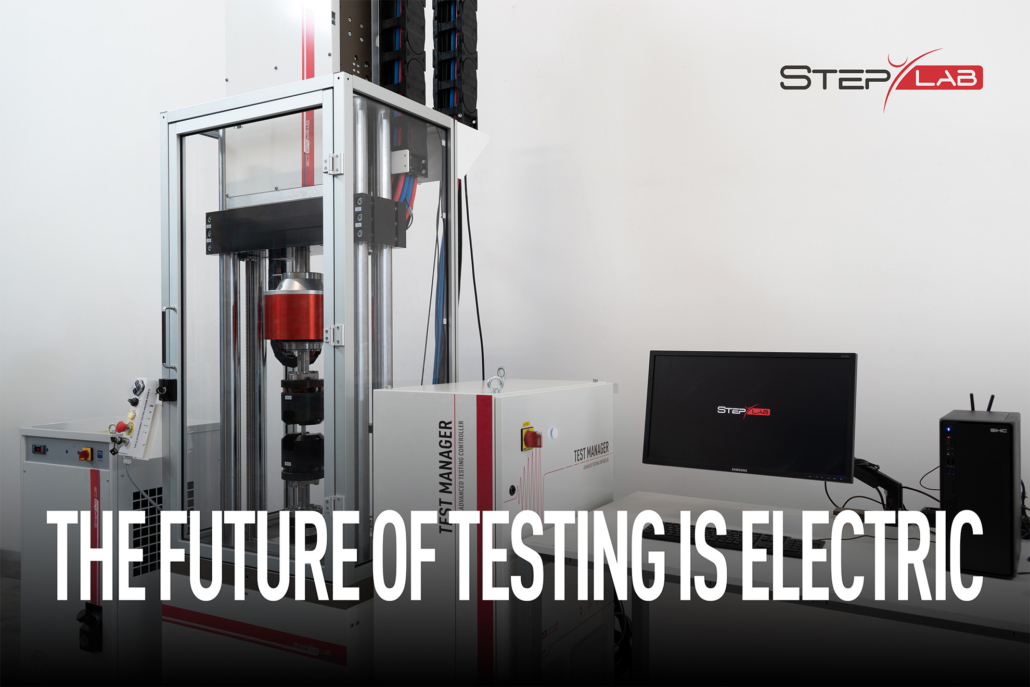
The future of testing is electric
After seven decades of oil-based dominance, the second testing revolution is here. Electrical actuation is replacing hydraulic systems across labs worldwide and the advantages go far beyond performance.
STEP Lab was born in 2007, as a pioneer of this revolution, from the first day it started with studying and developing testing systems based on electrical motions. STEP Lab is focused on technologies that could replace the older one oil-based in an efficient and high performing way. The product range currently is divided on two main families: EA and UD.
The two technologies
EA Series
Electromechanical actuators, based on high precision and high reliability ball screw.
This technology finds the best application on:
- Dynamic tests on position and force control-loop, up to 35 Hz, with acceleration up to 4 G
- Static tests on position control-loop
- Static tests on force control-loop (creep tests)
Currently the electromechanical actuator’s product range cover a wide force range: from <1 kN to above 200 kN of dynamic force. These values permit to replace the 95% of the world hydraulic applications on the testing field.
UD Series
Electrodynamic actuators based on high dynamic linear motors.
This technology is the best on the market for the following applications:
- Dynamic tests on position and force control-loop, with test frequency greater than 250 Hz, and acceleration >90 G
- High strain rate tests
- Reproducing in-lab the acquisition of time history with high dynamics
The maximum dynamic (fatigue) load reached by electrodynamical actuators is 100 kN. Actually, the linear motor’s technology allows to overcome this value.
Operational benefits of electrical systems
The electric actuation has a very high efficiency thanks to two important features:
Direct Drive
The electric energy transformed to mechanical energy is directly applied to the device under test (DUT), especially in electrodynamic (linear motor) actuators. In these actuators there’s no mechanical transmission: Electromagnetic force is directly transmitted from the linear motor to the actuator rod. This allows to obtain a very high efficiency of the system, usually above 85%.
“KERS” Effect (Kinetic Energy Recovery System)
In cyclic test, during the half-cycle when the machine has to decrease the energy of a sample, that energy is recovered and stored into capacitors, to be re-used during the next phase. This effect is much more relevant when testing speed and frequency are increased.
These two features allows to save 60% to 80% total energy compared to the hydraulic test system, and in few conditions (test frequency = sample’s natural frequency), the saving is above 90%.
Typical energy savings vs. hydraulic
Savings at resonant test frequency
Direct drive efficiency (linear motors)
Where electric wins
The advantages of electrical actuation span accuracy, dynamics, energy, uptime, running costs, and environmental impact. Below is a complete breakdown across every relevant dimension, with real comparative data where available.
Accuracy & repeatability
Electric
- Precise across the full velocity range (0.1 – 4,000 mm/s)
- Closed-loop position and speed control with repeatability within 1 µm
- Not affected by temperature variation or mechanical hysteresis
Hydraulic
- Good accuracy reachable (but only after long PID tuning)
- Mechanical valve limitations reduce precision at speed extremes
- Oil temperature, compressibility, valve hysteresis and seal friction all affect repeatability
Dynamic test performance
For fatigue tests, what matters is the RMS value of the applied load, which means a dynamic actuator can deliver a higher peak amplitude than its static rating suggests. For shock or peak tests, brushless DC motors can accept a momentary current overload to produce extra force for a few seconds. No special hydraulic pressure-storage circuits needed.
| Specification | Electric (e.g. STEP Lab KUD080-L2) | Hydraulic (COMPETITOR) |
|---|---|---|
| Stroke | 300 mm / 12 in | 250 mm / 10 in |
| Peak performance | 41 kN @ 5.0 m/s | 33.5 kN @ 3.5 m/s (180 gpm HPU) |
| HPU required | Not needed | 525,600 unit (1,960 l) |
| Uptime (typical) | 95% (+876 hours/year) | 85% |
Energy consumption & Operational efficiency
Transitioning from hydraulic to electric actuation represents a paradigm shift in energy management and cost reduction. Unlike hydraulic power units, which must run continuously at full pressure regardless of demand, electric actuators consume power only during movement. Furthermore, they utilize built-in capacitors for kinetic energy recovery (KERS), capturing energy during deceleration and feeding it back into the system. Independent research by the Ostfalia University of Applied Sciences confirms that electric systems can be up to 6 times more efficient than traditional hydraulic setups.
Comparative cost analysis (per 1,000 operating hours)
| Parameter | Electric (e.g. STEP Lab KUD080-L2) | Hydraulic (Competitor) |
|---|---|---|
| Power draw | 85 kW | 270 kW |
| Energy consumption | 85 MWh | 270 MWh |
| Annual running cost* | $ 53.800 | $ 170.880 |
*Based on an energy cost of $85/MWh.
Annual savings by switching to electric
Maintenance costs
Hydraulic systems require regular fluid and seal management. Electrical actuators need only periodic greasing of the linear guides, everything else drops to zero.
| Item | Electric (yearly) | Hydraulic (yearly) |
|---|---|---|
| Oil | $0 | $2,500 |
| Filters | $0 | $750 |
| Pipes & seals | $0 | $3,000 |
| Chiller | $500 | $500 |
| Total | $500 | $6750 |
Safety, environment & noise
Electric
- Zero oil leaks, no fire risk from hydraulic fluid
- No oil vapours, cleanroom compatible
- No waste oil disposal costs
- Actuator noise: ~55 dB at rest, ~68 dB active
- No hearing protection or soundproofing required
Hydraulic
- Oil leaks require regular floor cleaning
- Oil vapours pollute air and environment
- Costly regulated waste oil disposal
- HPU noise: ~72 dB (often requires hearing protection)
- Special infrastructure may be needed for noise isolation
Conclusion
The shift from hydraulic to electrical testing is not a future prospect, it is an ongoing transition. The technology is mature, the coverage is broad, and the total cost of ownership increasingly favours electric systems across accuracy, energy, maintenance, and environmental dimensions.
With complete electric architectures, STEP Lab’s systems offer cleaner operation, higher accuracy, and lower lifecycle cost compared to hydraulic alternatives.
If you’re looking for a fully electric testing machine, STEP Lab provides one of the most advanced and reliable solutions on the market.
| Features | Electric | Hydraulic |
|---|---|---|
| Accuracy | Precise across all speeds; closed-loop control of position and speed | Good after long PID tuning; struggles at very high or very low speeds |
| Force range | Overlap <1 kN – 200 kN; covers 95% of use cases | 1 kN – 2,000 kN; preferred above 200 kN |
| Dynamic tests | Up to 250+ Hz; peak overload possible via motor current boost | Works, but limited by mechanical valve response |
| Energy consumption | 60–80% less; KERS energy recovery during cyclic tests | Continuous full-power operation regardless of actual demand |
| Installation | Plug and play (electrical connection only) | Complex setup; requires hydraulic power unit infrastructure |
| Maintenance | Minimal (periodic greasing of linear guides only) | Regular oil changes, seal replacements, leak management |
| Air & env. pollution | Zero (cleanroom compatible) | Oil vapours, leaks, costly waste oil disposal |
| Operating noise | Typically below 60 dB | High (may require hearing protection or soundproofing) |
FAQ
Can electrical actuators fully replace hydraulic ones?
What is the difference between electromechanical and electrodynamic actuators?
How much energy do electrical actuators really save?
Typically between 60% and 80% compared to an equivalent hydraulic system. This is achieved through two mechanisms: direct drive (no mechanical transmission losses) and a kinetic energy recovery system (KERS) that captures and stores energy during the deceleration phase of cyclic tests. In resonant test conditions, savings can exceed 90%.
Are electrical actuators suitable for cleanroom environments?
How complex is the installation compared to a hydraulic system?
Contact STEP Lab
Want to find out more about our electric testing solutions? Contact us for any requests, detailed technical specifications, and customised configurations.