
What is End-of-Line testing?
End-of-Line (EOL) testing is a comprehensive functional test performed at the very end of the production process. Unlike R&D testing, which explores the limits of a design, EOL testing is about validation and pass/fail execution.
For automotive components like shock absorbers, EOL testing verifies that the assembly was performed correctly and that the component performs within the specific damping force tolerances required by the OEM.
Why End-of-Line testing matters for quality and safety?
In the automotive industry, a single faulty shock absorber can compromise vehicle stability and passenger safety. EOL testing provides:
- 100% Quality assurance: Every single part is tested, not just a sample.
- Liability protection: Digital records of every serial number prove the part met specs at the time of shipment.
- Takt-Time efficiency: High-speed testing ensures that quality checks do not become a bottleneck in the production flow.
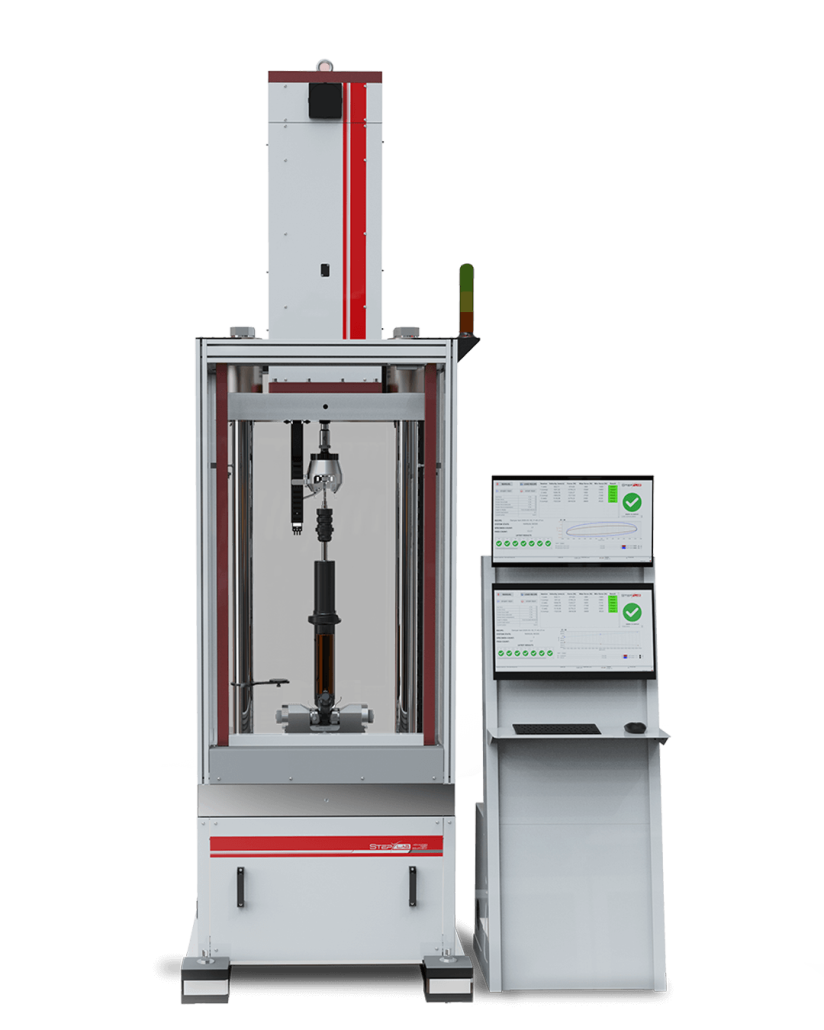
EOL testing machine based on HUD020
EOL testing process
A typical EOL cycle for shock absorbers involves several automated steps to minimize human error and maximize throughput:
- Identification: A bar code reader scans the part’s serial number.
- Loading: The part is secured using automatic or manual grips.
- Execution: The machine runs a predefined dynamic cycle (compression and extension).
- Analysis: Software compares the results against a “Master Curve.”
- Disposition: The part is either marked as “OK” or sent to a sensored scrap area.
Common EOL test types
- Damping force measurement: Characterizing the force-velocity curve.
- Gas pressure check: Ensuring the internal pressure is correct.
- Friction testing: Measuring the internal mechanical resistance.
- Noise/NVH: Detecting “clicking” or abnormal sounds during operation.
EOL testing for shock absorbers: The STEP Lab approach
STEP Lab EOL systems are engineered to handle high duty cycles with two primary technologies:
- Linear motor systems
-
- Based on HUD Series
- Maximum load up to 66 kN
- Speeds up to 6.5 m/s
- High dynamic
- Electromechanical systems
- Based on EA Series
- Maximum load up to 50 kN
- Speeds up to 1.25 m/s
- Cost-effective
Main features and Accessories
- Safety fences
- Infrared barrier
- Automatic transparent door
- Crossbar closure
- Wide range of grips
- Full automatic grips closure
- Automatic S/N scanning
- Management of semi-active/active suspensions (electronic valves)
- Instant failure identification
- Sensored scrap area
- Integration with the customer’s network and database
- Bar code reader
- User-friendly interface
Conclusion
EOL testing is the final line of defense in manufacturing. By integrating high-performance actuators with smart software, STEP Lab ensures that every damper leaving your line is safe, reliable, and perfectly calibrated.
Want to find out more about our End-of-line test systems? Contact us for any requests, technical specifications, and customised configurations.
FAQ
How does EOL testing differ from R&D testing?
R&D testing is used during the design phase to find the breaking point of a component or to validate a new concept. Durability testing (fatigue testing) focuses on how a part wears out over time. In contrast, EOL testing is a functional check performed on 100% of finished products to ensure they were assembled correctly and meet the specific performance criteria before shipping.
What is "Takt Time" in the context of EOL testing?
Takt time is the rate at which a finished product must be completed to meet customer demand. An EOL testing station must be fast enough to test the product within this window. If a production line produces a part every 30 seconds, the EOL test must be completed in significantly less than 30 seconds to avoid becoming a bottleneck.
What is a "Master Curve" in damper testing?
A Master Curve is the “perfect” performance profile of a component. During EOL testing, the software compares the real-time data from the part on the machine against this reference curve. If the damping force falls outside the allowed tolerance (the “envelope”), the part is rejected.
Can EOL testing be fully automated?
Yes. Modern EOL stations are often integrated with robotic arms for loading/unloading and use barcode scanners to automatically pull testing parameters from a central database. This removes human error and ensures total traceability for every unit produced.