
Biomechanical Testing: Applications in Medical Devices
Medical devices that interact directly with the human body, prosthetic limbs, orthopedic implants, footwear-related aids, cannot be validated the same way as a bracket or a chassis component. They have to survive the repetitive, sometimes unpredictable forces the human body generates every day. Biomechanical testing reproduces those loads on a bench, before the device reaches a patient.
What Is Biomechanical Testing?
Biomechanical testing is the application of mechanical test methods, static and dynamic loading, cyclic fatigue, controlled displacement, to devices that are designed to interact with the human body. Unlike standard materials or component testing, the load profiles here are not arbitrary: they are derived from human movement, most commonly gait (walking) data, and must be reproduced with high fidelity in terms of magnitude, direction, and timing.
The goal is twofold. First, verify structural integrity: will the device withstand years of daily use without cracking, deforming, or failing catastrophically? Second, verify functional performance: does the device behave the way it’s supposed to under realistic, dynamic conditions, not just under a single static load?
A device can pass a basic static strength test and still fail in the field, because real use means millions of load cycles at varying rates, not one slow push.
Key Applications in Medical Devices
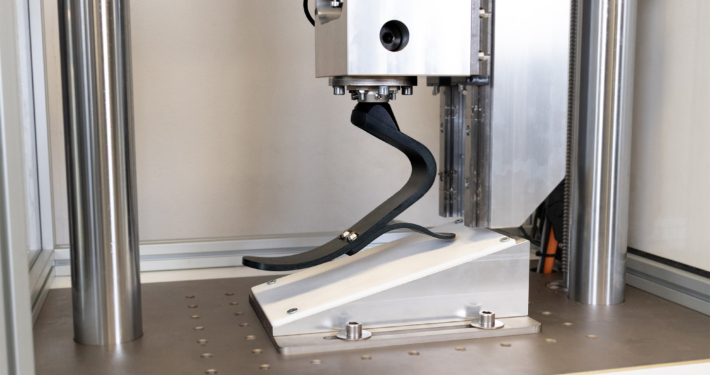
- Lower-limb prosthetics are the most common application. Ankle-foot devices and foot units are tested by applying cyclic loads that replicate the stance phase of walking, from heel strike to toe-off, for hundreds of thousands of cycles, alongside static proof and ultimate strength tests. The objective is to confirm the device won’t fail under normal use and to establish its service life.
- Upper-limb prosthetics and orthopedic components follow a similar logic: cyclic loading profiles simulate grip, lifting, or joint articulation forces over the expected product lifetime.
- Orthopedic and footwear-related devices (braces, orthotic soles, supports) are tested for fatigue resistance under repeated loading that mimics body weight transfer during walking or running.
A practical example: a manufacturer developing a new prosthetic foot needs to demonstrate that the device meets strength and durability requirements before it can be marketed. Instead of relying only on field trials, which are slow and hard to control, the manufacturer runs cyclic tests on a bench system that reproduces the heel-strike and toe-off load path, at the cycle counts and force levels defined by the relevant standard, while measuring deflection and monitoring for cracks or permanent deformation. This produces objective, repeatable data that a purely qualitative field trial cannot.
Which Testing Approach Do You Need?
The right approach depends on where the device is in its lifecycle:
- Regulatory validation: the device design is finalized and needs to demonstrate compliance with a recognized standard before market release. Testing here follows the standard’s exact load profile, cycle count, and pass/fail criteria.
- Product development: the design is still being refined. Testing is used iteratively, often with modified or accelerated load profiles, to compare design variants and identify weak points before committing to regulatory testing.
Both approaches rely on the same core capability: a test system that can reproduce dynamic, physiologically realistic loads with precision and repeatability.
Relevant Standards
| Standard | Scope of Application |
|---|---|
| ISO 22675 | Cyclic and static test procedures for ankle-foot devices and foot units for lower limb prostheses, simulating the stance phase of walking |
| ISO 10328 | Structural testing (static and cyclic strength) of lower limb prostheses as a whole |
| ISO 16955 | Characterization of prosthetic feet |
| ISO 7206-4 / ISO 7206-6 | Endurance properties and performance requirements of stemmed femoral components for hip prostheses |
| ISO 11491 | Impact resistance of ceramic femoral heads for hip prostheses |
| ISO 14801 | Dynamic loading test for endosseous dental implants |
The full list of biomedical standards STEP Lab tests against is on our ISO standards page.
STEP Lab Testing Solutions
STEP Lab’s full electric test systems are built to reproduce exactly this kind of physiologically-driven, cyclic loading, without the fluid, maintenance, and infrastructure overhead of a hydraulic setup. Our Test Center software allows precise, closed-loop control of complex, non-sinusoidal load and displacement profiles, which is what realistic gait-based testing requires.
We’ve applied this approach to develop a dedicated prosthetic testing module within Test Center, purpose-built to run ISO 22675 / ISO 10328 cyclic and static test sequences on lower-limb ankle-foot devices, with full data acquisition and reporting.
Frequently Asked Questions
What is biomechanical testing?
Biomechanical testing is the application of mechanical test methods, including static loading, cyclic fatigue, and controlled displacement, to devices designed to interact with the human body, such as prosthetics and orthopedic implants. Unlike standard component testing, load profiles are derived from real human movement, most commonly gait data from walking.
What’s the difference between biomechanical testing and standard fatigue testing?
Biomechanical testing uses load profiles derived from real human movement (like gait cycles) rather than a generic sinusoidal or block load, and it’s applied specifically to devices that interact with the human body.
Can the same test system be used for both prosthetics and other medical devices?
Yes, as long as the system can reproduce the specific load profile, magnitude, and cycle count required. Electric actuator platforms are well suited to this because load profiles can be reprogrammed in software rather than requiring mechanical changes.
How many cycles does a typical prosthetic durability test require?
Cycle counts are defined by the applicable standard and can reach several hundred thousand cycles, since the goal is to simulate years of daily use.
What is the stance phase of gait?
The stance phase of gait is the portion of the human walking cycle during which the foot is in contact with the ground, starting at heel strike and ending at toe-off. It’s the phase that generates most of the load a lower-limb prosthesis must withstand.
Contact Us
Want to know how our solutions can support your biomechanical testing needs? Get in touch with our team.